
williamhkeyq@gmail.com
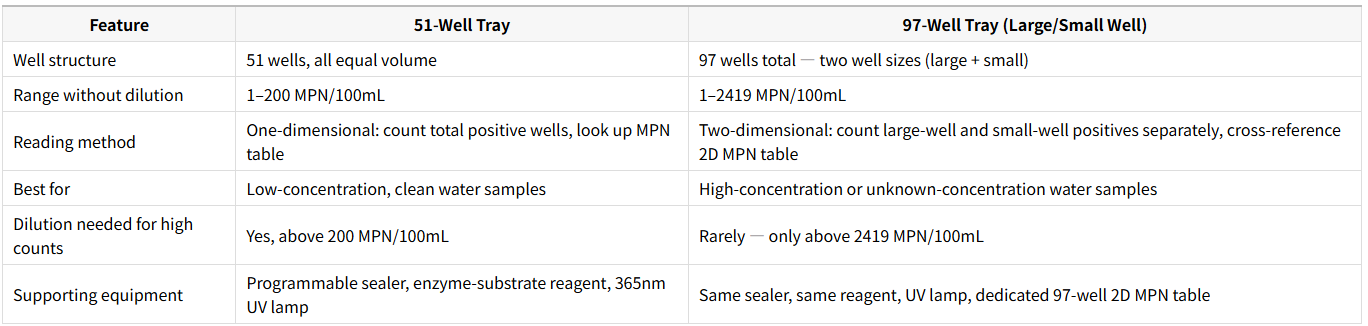
Quick answer: Both the 51-well and 97-well trays are enzyme-substrate MPN (Most Probable Number) quantification trays used for coliform and E. coli testing in water. The key difference is well structure, measurement range, and reading method — the 51-well tray suits clean, low-concentration water, while the 97-well tray suits high-concentration or unknown-concentration water samples.
An MPN quantification tray is a water microbiology testing consumable used to quantify total coliforms and E. coli. A fixed 100 mL water sample is mixed with an enzyme-substrate reagent, dispensed into the tray's wells, and heat-sealed with a programmable sealer. After incubation, positive wells are identified by color change or fluorescence under a 365nm UV lamp, and the count is converted into a bacterial concentration (MPN/100mL) using the Most Probable Number statistical method.
Note: these wells are not the same as a standard 96-well cell culture plate. A cell culture plate uses microliter-scale volumes, while a quantification tray always starts from a full 100 mL water sample — the wells simply divide that sample into fixed-ratio aliquots.
Finished water / distribution network tap water
Purified water, bottled water
Secondary water supply systems
Medical-grade purified water
These water types are subject to strict regulatory limits and typically carry low bacterial loads. The 51-well tray delivers a tighter confidence interval and better precision at low concentrations.
Surface water, groundwater, raw water
Wastewater, reclaimed water, gray water
These samples often span a wide concentration range. The 97-well tray's broad detection range allows testing without prior dilution, eliminating the extra error that dilution steps can introduce — especially useful when contamination levels are unknown.
Treating the 97-well tray like a 51-well tray. The 97 wells are not equal in size. Reading only the total positive-well count and matching it to the 51-well one-dimensional table is the most frequent error — large-well and small-well positives must be counted separately and checked against the two-dimensional MPN table.
Confusing it with a cell culture plate. Both tray types start with a full 100 mL water sample, not a microliter-scale reaction. This is unrelated to standard 96-well cell culture plates in molecular or cell biology labs.
Mishandling range overflow.
51-well tray result > 200 MPN/100mL → dilute the sample and retest, or switch to a 97-well tray.
97-well tray result > 2419 MPN/100mL → perform a serial dilution and retest, then scale the result by the dilution factor.
Clean drinking water, low concentration, strict limits → 51-well traySurface water, raw water, wastewater, high/unknown concentration → 97-well tray
Q: Can I use a 97-well tray for drinking water testing?A: Yes, technically, but the 51-well tray offers better precision at low concentrations, so it's generally preferred for clean, low-bacterial-load samples like finished drinking water.
Q: What happens if my 51-well tray result exceeds 200 MPN/100mL?A: Dilute the sample and retest, or switch to a 97-well tray, which has a much wider measurement range (up to 2419 MPN/100mL).
Q: Why does the 97-well tray need a different reading method?A: Because it contains two well sizes (large and small) rather than uniform wells. Positive counts from each size must be tallied separately and matched against a two-dimensional MPN reference table, rather than a simple one-dimensional lookup.
Q: Is a quantification tray the same as a 96-well cell culture plate?A: No. A quantification tray processes a full 100 mL water sample divided across its wells for MPN calculation, while a 96-well cell culture plate is a microliter-scale vessel used for cell culture — the two serve entirely different purposes.
Product summary for international trade / product listing use:
51-Well Tray — Range: 1–200 MPN/100mL. Ideal for potable water, purified water, and bottled water testing.
97-Well Tray — Dual-size wells. Range: 1–2419 MPN/100mL. Ideal for raw water, surface water, and wastewater testing.